Christopher Nolan’s The Odyssey (released 17 July 2026) was filmed in large part in Messinia — mostly within the same area covered by our own “Pylos & Voidokilia” day trip. Below is a rundown of exactly where filming took place, what you can actually visit, and what stays deliberately off-limits.
One note upfront: the Palace of Nestor (Ano Englianos) and Ancient Messini get mentioned in some articles for their mythological atmosphere, but they are not confirmed filming locations for this production. We’ve deliberately left them out here.
Voidokilia: the beach where Nolan landed his Cyclops
Voidokilia, with its distinctive crescent shape (the Greek letter Omega), served as the main backdrop for the Cyclops sequence, including three triremes beaching on the sand. The bay’s natural amphitheatre shape also solved practical problems with IMAX camera angles.
The beach is freely accessible and sits about 50 minutes from Kalamata. It’s already part of our existing Pylos & Voidokilia day trip — the same trip now also takes you to an actual filming location.
Nestor’s Cave: why you can’t (yet) visit this location
Right next to Voidokilia lies Nestor’s Cave, a coastal cave with its own place in Greek mythology. Part of the Cyclops scenes were filmed inside the real, cold, echoing cave. What most articles leave out: the cave is closed to the public, and the entrance is only visible from a distance.
We mention this deliberately — not to encourage you to find a way in, but to save you a wasted trip to a closed location. Admire the entrance from a distance and head on to Voidokilia itself.

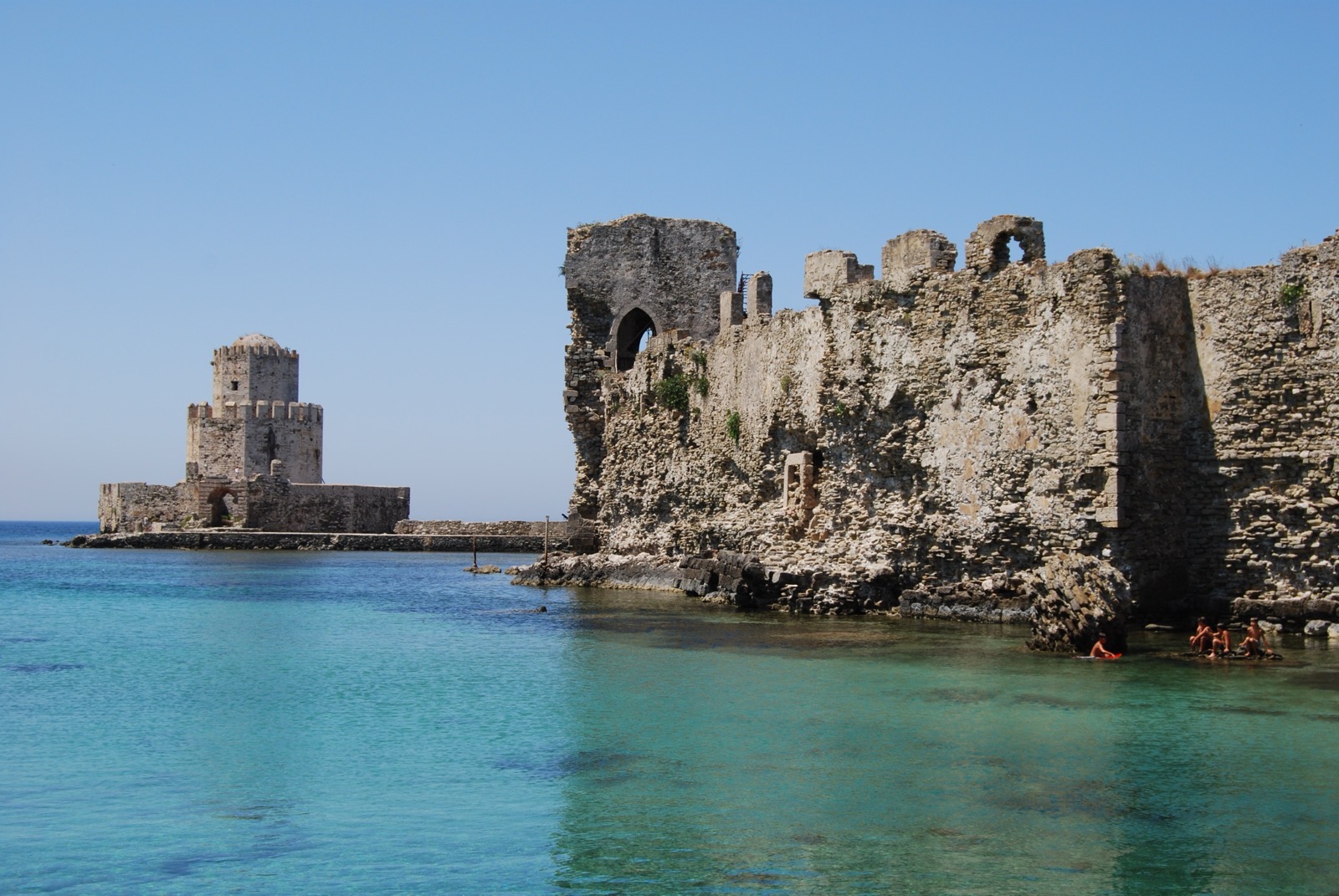
Castle of Methoni: from fortress to film palace
The fifteenth-century Venetian castle of Methoni served in the film as the palace of Menelaus and Helen. At about 1 hour 10 minutes from Kalamata, this is the furthest location on this list, but with one of the finest fortresses in the Peloponnese, it’s well worth the drive.
The castle is freely accessible as a museum site and easy to explore on foot — including a walk all the way to the Burtzi, the small fortress at the tip, where waves crash against the rocks in windy weather. The beaches around Methoni itself are beautiful and noticeably quieter than the busier coast around Kalamata.
Sapienza: the island off the coast of Methoni
Right off the coast of Methoni lies Sapienza, an uninhabited island with clear-water coves. You can’t just land there without a permit — the usual way is to book a boat trip from Methoni, a roughly 20-minute ride to the first beach (Ammos). Shorter two-hour trips suit those who mainly want to swim, while longer half-day excursions let you explore the island more fully. In peak summer (July–August), booking ahead is worthwhile.
Pylos after The Odyssey
The Bay of Navarino near Pylos served as the backdrop for the fleet-gathering scenes in the film. Local press reports that Pylos and Kalamata have already seen increased visitor numbers since release. Pylos also sits about 50 minutes from Kalamata and is freely accessible.
Extra background for a visit: the Old Castle of Navarino (Palaiokastro), a Frankish-Venetian fortress on a hill right above Voidokilia, makes a good additional stop with views over the bay and lagoon — unrelated to the film, but easy to combine on the same day.
Want to visit the filming locations yourself? Here’s how to do it without the crowds
There’s real local concern about the attention this film brings — comparisons to Dubrovnik after Game of Thrones are already being made. At the same time, the Messinia hoteliers’ association has welcomed the production, pointing to the precedent of Mamma Mia!, which gave the Sporades a lasting tourism boost.
Our approach: come, but spread your visit across the season, choose small groups over big buses, and spend your money at local tavernas and businesses rather than just photographing the entrance to a filming location. That’s also how we’ve been running this trip for years — long before any camera showed up.
Want to visit these places yourself with local guidance? Check out our Pylos & Voidokilia day trip.
Book a tour
Want to explore Kalamata and Messinia with a local guide? Check out our small-group tours.
View all tours